
What is Effective Area?
Effective Area (AK) of an air outlet (grille, register, or diffuser) is the net flow area that actually carries the air stream — not just the nominal face dimensions. It accounts for elements like fins, louvers, and other obstructions.
Because the “free” or “open” area is reduced by those obstructions, the nominal area doesn’t reflect the real airflow capacity; Effective Area gives a realistic measure for airflow calculations.
To estimate volumetric airflow (Q) from an outlet you use:
To estimate volumetric airflow (Q) from an outlet you use:
Q = Velocity × Effective Area (AK)
Q= V × AK
Where:
Q (Airflow): The amount of air coming out of the grille or diffuser.
V (Velocity): The speed of air at the outlet face.
AK (Effective Area): The actual net area through which air flows at the outlet.
What is Effective Area?
Why Effective Area is Important?
Without using the Effective Area, the airflow capability of an outlet can be overestimated, since the nominal area is always larger than the real net area.
By using the Effective Area + actual velocity measurements at the outlet, we obtain the true and accurate airflow (Real Flow), ensuring that each room receives the required design airflow for proper cooling, heating, and ventilation.
This is especially important in critical projects such as hospitals, laboratories, and large commercial buildings, where indoor air quality, comfort, and system performance are essential.
Using real field measurements in TAB reports and handover documentation also enhances the accuracy and professional credibility of SABER Engineering Company.
How to Calculate Area Factor / Effective Area?
Obtain the outlet specifications (grille/diffuser), including the face dimensions
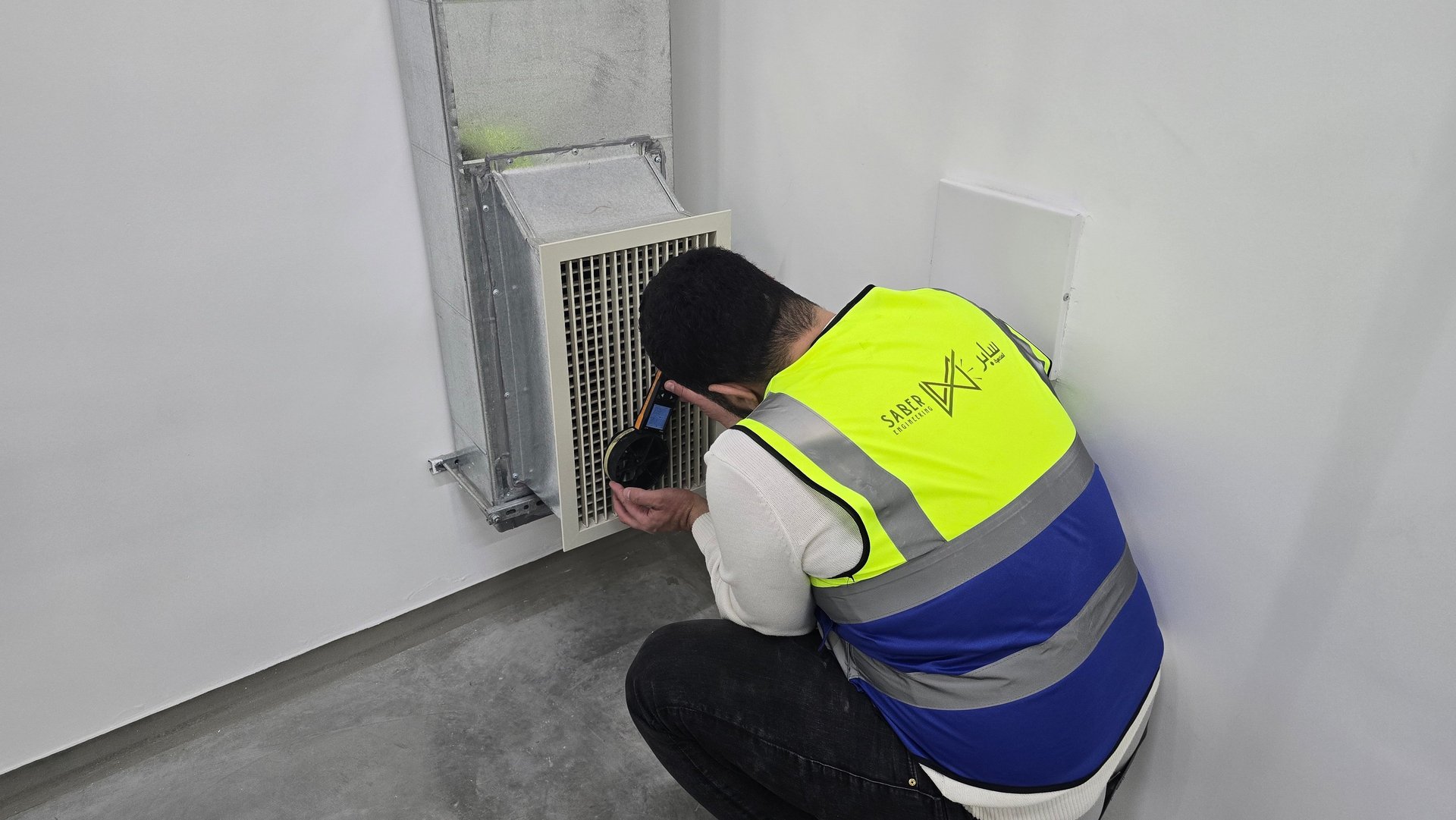
Measure the face velocity (V) at the outlet using Rotating vane
Calculate the airflow (Q) using the following formula:
Q= V × AK
AK=Area × Area Factor
Example
Given:
Outlet type: Supply grille
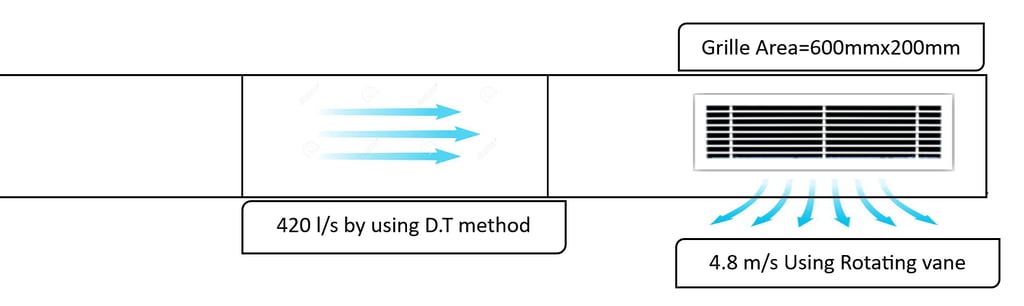
Grille size: 600 × 200 mm (24×8 inch)
Duct airflow (true measured flow): 420 L/s (obtained using a Duct Traverse method)
Measured face velocity at the grille: 4.8 m/s (using Rotating vane)
Total Area = 0.6m × 0.2m = 0.12m
The idea is to compare the airflow measured using the most accurate method duct traverse inside the duct with the airflow passing through the outlet. However, we must ensure that there is no air leakage at duct joints or between the duct and the outlet, and that all measurements are taken under the same operating conditions.
Q(Duct Traverse) = Q(Grille)
0.42m³/s = V(Grille) × Area(Grille) × Area Factor
0.42m³/s = 4.8m/s × 0.12m² × Area Factor
Area Factor = 0.73 or 73%
Effective Area =Area × Area Factor
Effective Area = 0.12 × 0.73 = 0.0876m²
Using Effective Area from Manufacturer Data Sheet
Table from Cooling Industries Company - CIC Data sheet
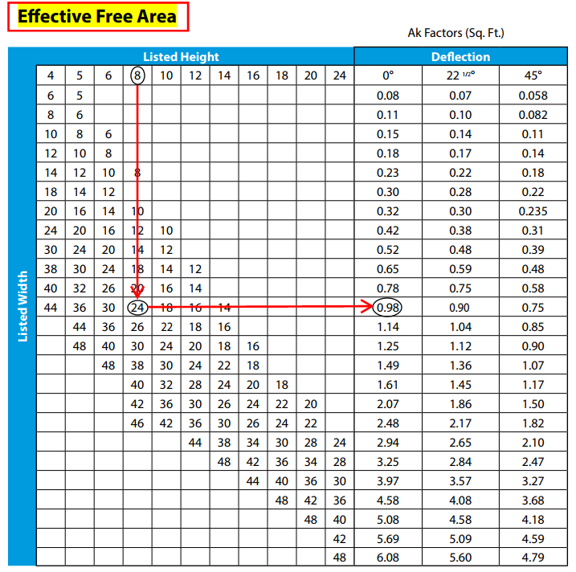
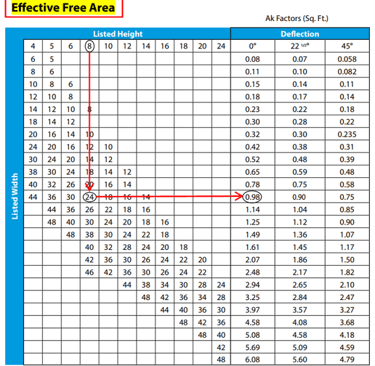
For a 600×200 mm (24×8) inch grille: Effective Area = 0.98 sq.ft = 0.091 m²
Area Factor = Effective Area ÷ Area =0.091 ÷ (0.6×0.2) = 0.758 or 75.8%
You don't always have to determine the Effective Area (Ak) through field measurements. If on-site measurement is not possible, use the Ak values provided by the manufacturer, as shown in the table below.